
The UAE Accedes to the Singapore Convention on Mediation: Cross-Border Commercial Settlement Enforcement Framework Under Federal Decree No. 85 of 2026
 Ayush A Haq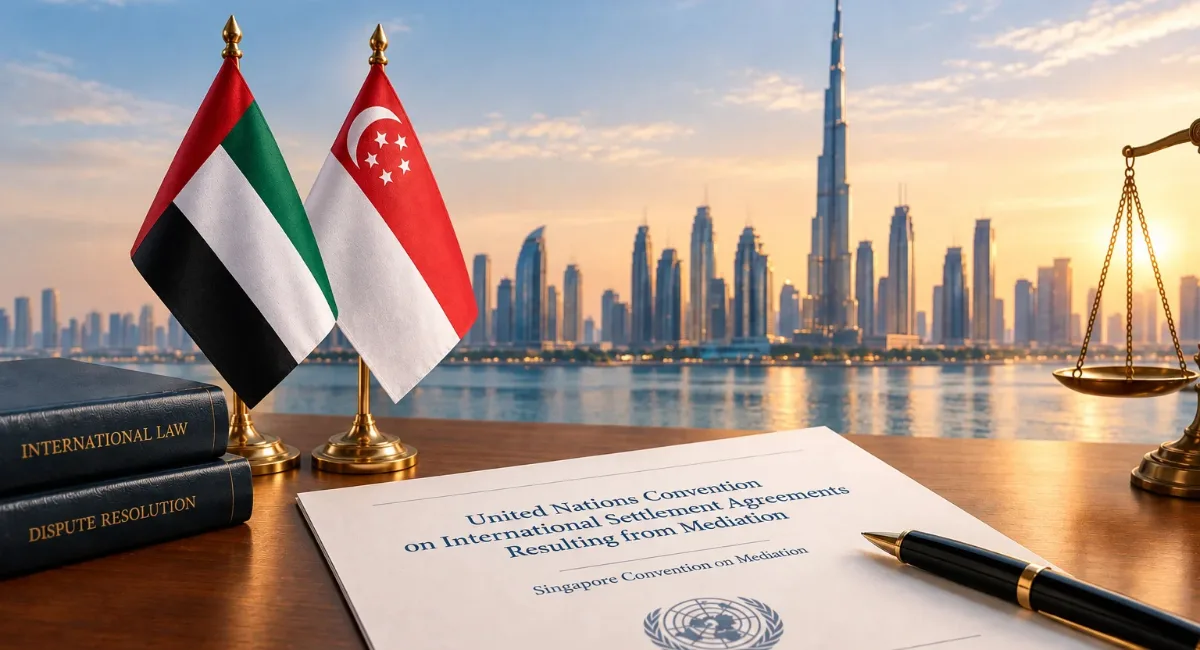
Through Federal Decree No. 85 of 2026, issued on June 8, 2026, the United Arab Emirates officially approved its accession to the United Nations Convention on International Settlement Agreements Resulting from Mediation (commonly known as the Singapore Convention on Mediation).
This accession establishes a standardized legal framework for the direct recognition and cross-border enforcement of international commercial mediated settlement agreements within contracting states. The regime is scheduled to enter into force six months after the formal instrument of accession is deposited with the UN Secretary-General, strengthening the UAE’s position as an international dispute resolution hub in the Middle East.
The Pre-Convention Legal Paradigm vs. Direct Enforcement Mechanism
Prior to accession, mediated settlement agreements were categorized under general contract law. In instances of non-performance or breach, an aggrieved commercial party had to initiate court or arbitration proceedings to obtain a judgment or arbitral award—essentially litigating the underlying dispute to enforce the agreement.
The Singapore Convention eliminates this multi-stage enforcement barrier. Once in force, qualifying settlement agreements can be enforced directly before local courts without relitigating the merits or converting the settlement into a court judgment or arbitral award. Parties may also rely on the settlement agreement offensively for direct performance or defensively to demonstrate that a claim has already been resolved.
Statutory Thresholds for Applicability
To qualify for direct enforcement under the Convention, a mediated settlement agreement must satisfy four cumulative requirements:
- Written Form: The agreement must be in writing and formally signed by all participating parties.
- Commercial Nature: It must resolve a commercial dispute between economic entities.
- Evidence of Mediation: The settlement must demonstrate that it resulted from mediation, verified via the mediator’s signature or an official attestation from the administering dispute resolution institution.
- International Scope: Pursuant to Article 1(1), the dispute qualifies as international if either:
- At least two parties maintain their principal places of business in different sovereign states; or
- The state where the parties maintain their places of business differs from either the state of substantial performance or the state with which the subject matter is most closely connected.
Key Statutory Exclusions and UAE Specific Reservations
The Convention’s scope is circumscribed by express statutory exclusions under Article 1 and two specific reservations deposited by the UAE under Article 8:
Express Statutory Exclusions (Article 1)
- Consumer & Personal Disputes: Transactions entered into by a consumer for personal, family, or household purposes.
- Excluded Law Domains: Disputes involving family law, inheritance, or employment relationships.
- Overlapping Jurisdictional Regimes: Settlements already approved by a court or concluded during court proceedings and enforceable as a court judgment, as well as settlements recorded and enforceable as arbitral awards under the New York Convention.
UAE Declarations and Reservations (Article 8)
- Governmental Immunity: The Convention will not apply to settlement agreements to which the UAE federal government, local emirate governments, public agencies, or entities acting on behalf of a government agency are party.
- Opt-In Requirement: The Convention applies exclusively where the commercial contract parties have explicitly agreed in writing that the Singapore Convention framework shall apply to their mediated settlement.
Refusal Grounds for Enforcement
Under Article 5 of the Convention, a competent court may refuse an application for direct enforcement under limited, exhaustively defined statutory grounds:
- Incapacity or Invalidity: Party incapacity, or where the agreement is null and void, inoperative, non-binding, or subsequently modified.
- Lack of Clarity or Fulfilled Performance: Unclear or incomprehensible obligations, or evidence that obligations have already been performed.
- Mediator Misconduct: Severe breach of applicable mediator professional standards, or failure to disclose circumstances raising justifiable doubts as to independence or impartiality that materially impacted a party’s decision to settle.
- Public Policy & Arbitrability: Where granting relief violates public policy or where the underlying dispute is non-settlable via mediation under local law.
Conclusion & Operational Considerations for Cross-Border Contracts
The UAE’s accession to the Singapore Convention bridges a key structural gap between international arbitration and commercial mediation. Commercial entities operating across UAE mainland and free zone jurisdictions should re-examine their standard dispute resolution clauses to evaluate whether incorporating express “opt-in” language for the Singapore Convention aligns with their risk management and cross-border enforcement strategies.