Can an AI System Be an ‘Inventor’? Delhi High Court to Decide in Landmark Patent Appeal
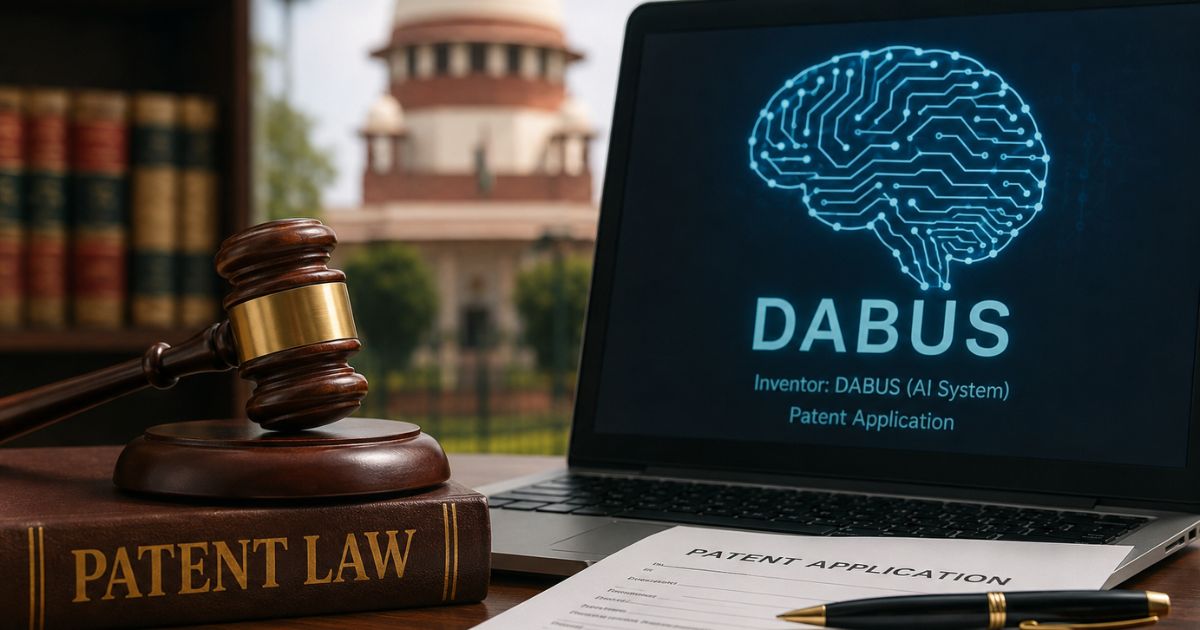
Can a machine be recognized as the “true and first inventor” of a patentable technology? This fundamental question at the heart of global IP debates has officially reached the Indian judiciary.
The Delhi High Court, presided over by Justice Jyoti Singh, recently issued notice to the Indian Patent Office in an appeal filed by American scientist Dr. Stephen Thaler. The appeal (Stephen Thaler v. Assistant Controller of Patents and Designs) challenges the rejection of a patent application that named DABUS an Artificial Intelligence system as the sole inventor.
As the first case of its kind to be heard by an Indian High Court, the matter promises to set a landmark precedent regarding the intersection of artificial intelligence, legal personhood, and patent protection under the Indian Patents Act, 1970.
Background of the Dispute
Dr. Stephen Thaler, a pioneer in artificial neural networks, created DABUS (Device for the Autonomous Bootstrapping of Unified Sentience). DABUS autonomously generated an invention for a food and beverage container featuring a wall with a unique fractal profile. This fractal design allows containers to interlock easily for storage while maintaining wall flexibility to facilitate separation.
When filing the Indian patent application titled “Food container and devices and methods for attracting enhanced attention”, Dr. Thaler designated DABUS as the sole inventor, while claiming ownership of the resulting patent rights for himself as the machine’s owner.
On April 15, the Assistant Controller of Patents rejected the application on three primary grounds:
- Lack of Inventive Step: The 9 surviving claims did not meet the statutory threshold for novelty/inventive step.
- Legal Ineligibility of AI as Inventor: DABUS could not be recognized as a “true and first inventor” under the Indian framework.
- Procedural Failure: Non-compliance with statutory requirements concerning the declaration of inventorship and proof of right.
Unsatisfied with the rejection, Dr. Thaler approached the Delhi High Court.
Key Legal Arguments Raised Before the Delhi High Court
The appeal presents several compelling statutory and policy arguments aimed at expanding how Indian courts interpret inventorship in the age of generative and autonomous AI:
1. Statutory Interpretation of Section 2(1)(y)
Under Section 2(1)(y) of the Patents Act, 1970, the term “true and first inventor” is defined largely through exclusion, specifically excluding the first importer of an invention into India and a person to whom an invention is first communicated from outside the country. The petitioner argues that the statute does not explicitly mandate that an inventor must be a natural human person.
2. Inventorship vs. Patent Ownership
Crucially, the appeal clarifies that Dr. Thaler is not requesting the Court to grant legal personhood, legal rights, or patent ownership to DABUS. Rather:
- DABUS is named solely as the inventor to accurately acknowledge the origin of the inventive concept.
- Dr. Thaler claims the patent rights as the creator, owner, and operator of DABUS.
3. Integrity of Disclosure and Misrepresentation
Naming a human (such as Dr. Thaler) as the inventor would require making a false statutory declaration, as the underlying concept was autonomously generated by the AI system.
4. Policy and Economic Considerations
Extinguishing patent eligibility for AI-generated inventions could disincentivize innovation and transparency. Inventors and companies might either omit AI involvement through false declarations or choose to protect breakthrough AI innovations as trade secrets, depriving the public of valuable disclosures.
Global Context: How Other Jurisdictions Have Ruled
India is not the first forum to examine Dr. Thaler’s global patent campaign for DABUS. The outcomes across major jurisdictions highlight a clear global divide:
- United States, United Kingdom, and European Patent Office (EPO): Courts in these jurisdictions rejected Thaler’s petitions, maintaining that relevant statutes strictly require human inventors. The UK Supreme Court (Thaler v. Comptroller-General) held in late 2023 that an inventor under UK patent law must be a natural person.
- South Africa: Uniquely, the Companies and Intellectual Property Commission (CIPC) of South Africa granted a patent naming DABUS as the inventor in 2021, making history as the first jurisdiction to do so (partly due to South Africa’s non-examining patent system).
The Delhi High Court’s decision will determine whether India aligns with traditional human-centric regimes or carves out a flexible interpretation suited for emerging technologies.
Key Takeaways for IP Owners and R&D Entities in India
As artificial intelligence moves from an assistive tool to an autonomous generator of technical solutions, businesses operating in India should consider the following practical implications:
- Audit AI Involvement in R&D: Document the extent of human contribution versus autonomous AI generation during research and development. Demonstrating substantial human oversight or iterative prompt engineering remains key to securing patent protection under current regulatory standards.
- Review Inventorship Declarations: Ensure that statutory filings accurately reflect human inventors who contributed to the technical conception to avoid challenges regarding improper inventorship declarations.
- Evaluate Alternative Protections: Until the judiciary or legislature provides statutory clarity, consider whether trade secrecy, copyright, or contractual protections offer safer interim coverage for purely AI-generated assets.
Looking Ahead
The Delhi High Court has directed the Indian Patent Office to submit its formal response, and the case is slated for its next hearing on September 18.
Whether the Court opts for a strict interpretation of the Patents Act or paves a path toward legal recognition of machine-generated inventions, the judgment will undoubtedly shape the future of IP strategy, R&D investment, and tech regulation in India.
By entering the email address you agree to our Privacy Policy.