DHA Standards for Medical Advertising on Social Media: Compliance Requirements, Misleading Claims Bans, and Facility Governance in Dubai
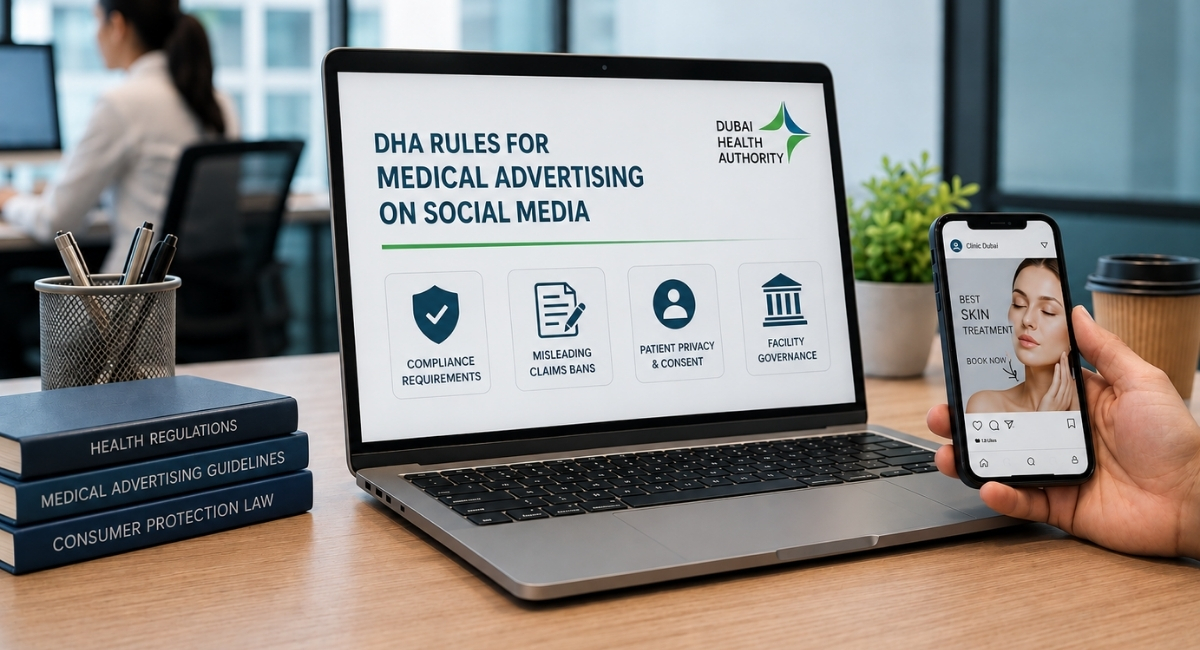
The Dubai Health Authority (DHA), through its Health Regulation Sector, officially published Circular CIR-2026-00000144 enforcing the updated Standards for Medical Advertisement Content on Social Media. This regulatory baseline establishes strict governance over how healthcare facilities, licensed medical practitioners, and digital content creators market medical treatments and health services online.
Designed to protect consumers from deceptive medical practices, psychological manipulation, and unverified clinical claims, the standard applies to all DHA-licensed healthcare institutions, clinical staff, and third-party influencers operating within the Emirate of Dubai (excluding the Dubai International Financial Centre and Dubai Healthcare City, which operate under separate administrative healthcare frameworks).
Statutory Framework and Governing Legislation
Medical advertising oversight in Dubai operates under a unified statutory framework combining federal legislative controls and local health authority governance:
- Executive Council Resolution No. 49 of 2024 Regulating Health Professions and Health Activities in Dubai;
- Federal Law No. 15 of 2020 on Consumer Protection (as amended by Federal Decree-Law No. 5 of 2023); and
- DHA Standards for Medical Advertisement Content on Social Media (DHA/HRS/HPSD/ST-21).
Under these rules, any digital media asset including paid social advertisements, organic video reels, clinic website landing pages, sponsored influencer visits, and instant messaging broadcast templates that mentions a medical service, procedure, or professional is legally classified as a regulated health advertisement.
Prohibited Marketing Practices and Unsubstantiated Claims
The DHA standard explicitly prohibits the use of absolute, superlative, or exaggerated terminology that creates unrealistic treatment expectations or pathologizes standard human anatomy.
Furthermore, healthcare providers are prohibited from utilizing inducement pricing tactics (such as emergency flash discounts or bundle promotions framing clinical services as consumer commodities) and comparative marketing asserting superiority over competitor facilities.
Internal Governance, Medical Director Liability, and Influencer Rules
A core component of the DHA framework is the centralization of administrative responsibility within the licensed healthcare facility:
1. Pre-Publication Approval Mandate
Healthcare professionals, marketing personnel, and contracted social media influencers cannot publish promotional content mentioning a clinic or service without prior internal review and formal authorization from the facility’s Medical Director.
2. Scope of Facility Responsibility
Healthcare facilities are held strictly liable for all media content recorded or filmed on their premises. This liability applies regardless of whether the video or image is distributed through the facility’s official corporate channels or via personal social media accounts maintained by doctors, employees, or third-party lifestyle influencers.
3. Separation of Personal and Professional Accounts
Licensed healthcare practitioners must maintain a clear boundary between personal accounts and professional medical profiles. Medical Directors are mandated to ensure that clinical staff do not engage in informal clinical consultations or promote unapproved medical services via personal social profiles.
Patient Privacy and Informed Written Consent
Patient confidentiality remains paramount under UAE health regulations. The DHA standard mandates that no patient image, video footage, voice recording, or written statement may be utilized in social media marketing without documented, explicit written consent.
- Consent Scope: Written consent forms must define the exact purpose, platform distribution, and permissible timeframe for media usage.
- Identity Shielding: Unless explicitly authorized under a valid consent agreement, patient identities and medical records must remain fully confidential.
- Before-and-After Content: Clinical before-and-after imagery is subject to heightened regulatory scrutiny. Images must not use misleading lighting, digital filters, or altered angles, and are restricted or entirely prohibited for certain specialized surgical procedures.
Conclusion & Compliance Considerations for Healthcare Facilities
The updated DHA standards mark a decisive transition toward evidence-based, transparent medical communication in Dubai’s digital space. For clinics, hospitals, and aesthetic centers, reliance on lifestyle influencer marketing and unverified promotional claims presents substantial regulatory exposure. Healthcare providers must establish formal internal submission workflows, audit social media channels, and obtain valid DHA advertising licenses prior to launching digital campaigns.
By entering the email address you agree to our Privacy Policy.