Dubai Whistleblower Protection Framework: Safeguard Measures and Employer Compliance under FAA Decision No. 2 of 2025
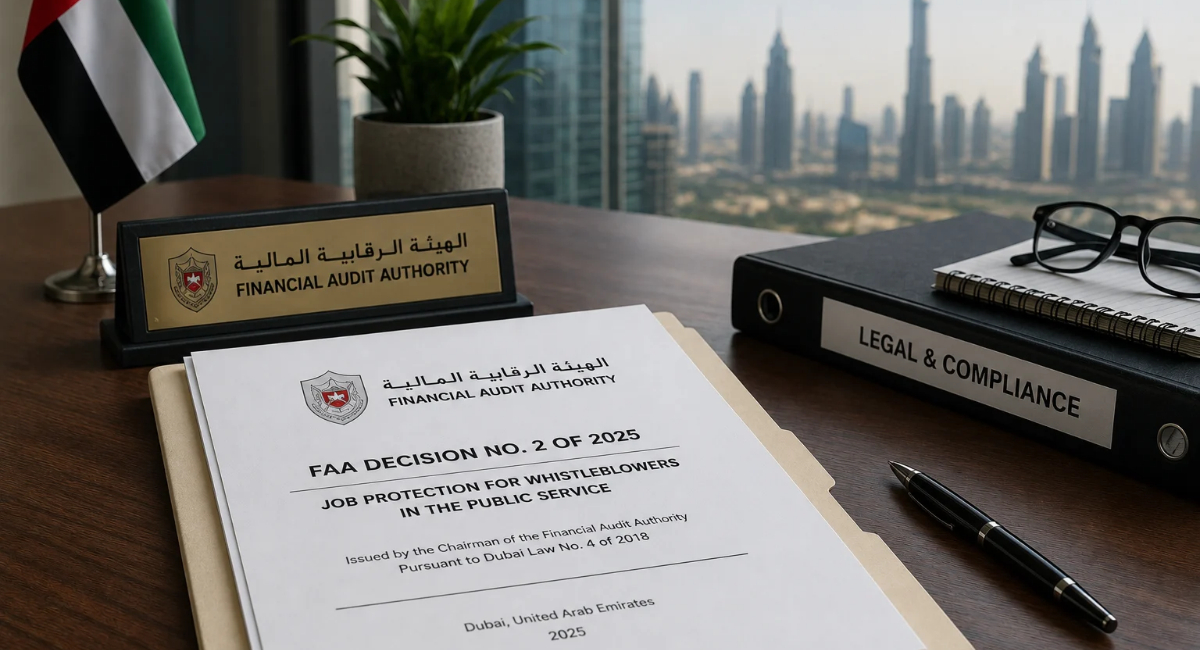
Financial transparency, fiscal integrity, and corruption prevention remain central pillars of Dubai’s governance strategy. A landmark development in this framework is FAA Decision No. 2 of 2025 on Job Protection for Whistleblowers in the Public Service, issued by the Chairman of the Financial Audit Authority (FAA) under Dubai Law No. 4 of 2018.
The decision establishes a formal administrative protection framework for employees within entities subject to FAA oversight who disclose financial or administrative non-compliance or testify during official inquiries. By creating secure reporting channels and legal safeguards against workplace retaliation, the FAA aims to safeguard public funds while embedding a culture of accountability across government and government-linked operations.
Scope of Application and Covered Entities
The remit of the Financial Audit Authority and consequently the reach of the whistleblower protection framework spans a broad spectrum of public and quasi-public institutions in the Emirate. Under Dubai Law No. 4 of 2018, audited entities include:
- Government departments, public agencies, and public corporations;
- Special Development Zones and Free Zones (including entities within the Dubai International Financial Centre); and
- Commercial companies in which the Government of Dubai holds a direct or indirect ownership stake of 25% or more.
The protective framework applies to any eligible employee within these covered entities who submits a good-faith report of a financial or administrative violation or provides testimony in an administrative investigation conducted by the FAA.
Key Reporting Safeguards and Protection Mechanisms
Whistleblower disclosures are facilitated through the Nazaha platform, a dedicated portal managed by the FAA designed to ensure strict confidentiality and secure data processing. Once a report is validated and protection status is approved, the FAA may implement targeted administrative remedies to protect the reporting party:
| Safeguard Area | Statutory Mechanism | Legal Impact |
| Identity Protection | Identity anonymization and strict confidentiality | Identity details are shielded from the employer and third parties throughout and after the investigation. |
| Anti-Retaliation Directives | Binding orders to audited entities | Instructs employers to refrain from adverse employment actions, demotions, or discriminatory measures. |
| Intervention & Reversal | Overturning retaliatory actions | Enables the FAA to intervene directly to suspend or annul disciplinary decisions linked to good-faith reporting. |
Institutional Oversight and Procedural Governance
Alongside whistleblower protections, the FAA framework complemented by FAA Decision No. 3 of 2025 (handling minor infractions) and FAA Decision No. 4 of 2025 (regulating Central Violations Committees and Grievance Committees) defines clear procedures for managing internal disputes and workplace violations:
- Investigation Due Process: Employees facing internal allegations must be formally notified of the charges and granted access to relevant case materials.
- Grievance Timelines: An employee seeking to challenge a disciplinary sanction must file a written grievance within 15 business days of formal notification.
- Committee Independence: To ensure impartial review, members of a Grievance Committee cannot have served on the initial Violations Committee and must hold equivalent or higher seniority than the aggrieved employee.
Limits of Protection: Malicious Disclosures
The legal framework balances whistleblower protection with safeguards against abuse. Protection status is not absolute and may be formally revoked if an investigation demonstrates that the disclosure was bad-faith, intentionally false, or malicious. Employees making false or bad-faith claims remain subject to internal disciplinary proceedings and statutory penalties under applicable UAE criminal and administrative laws.
Operational Considerations for Covered Entities
FAA Decision No. 2 of 2025 aligns Dubai’s public sector compliance standards with international whistleblower best practices. For executive leadership, legal counsel, and compliance officers within FAA-audited entities, maintaining internal compliance requires updating internal grievance policies, training management on anti-retaliation rules, and integrating reporting mechanisms with official channels.
By entering the email address you agree to our Privacy Policy.