
Shared Housing, Permits, Occupancy Rules, and Landlord Compliance in Dubai
 Joe Mathew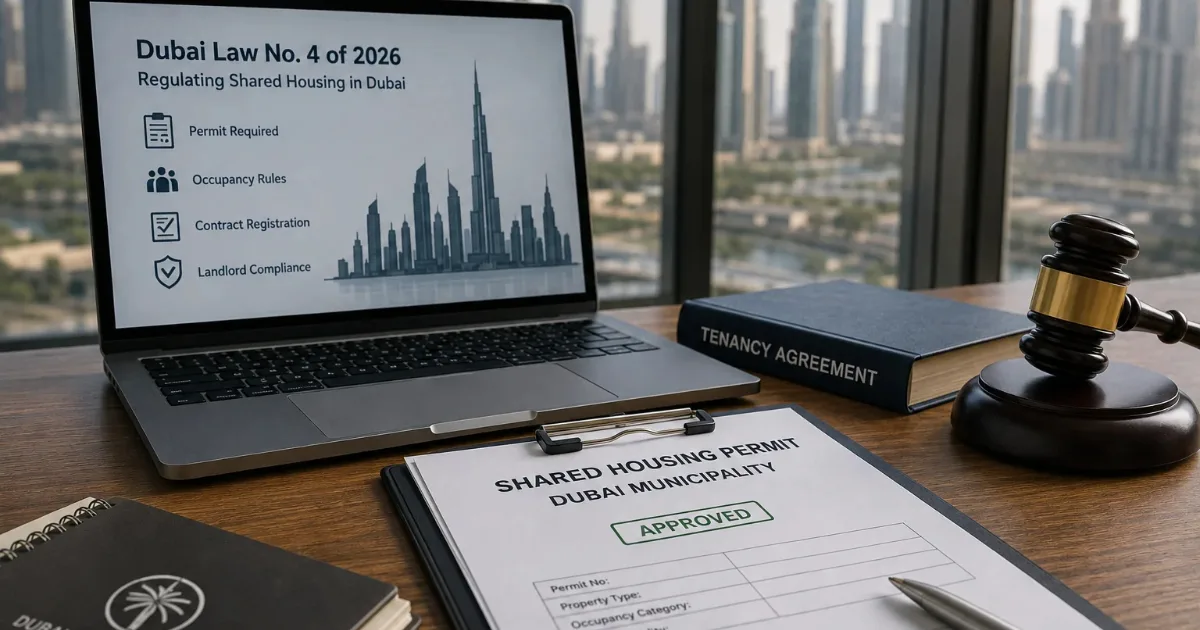
Shared housing has long served as an essential accommodation option for professionals, students, and families in Dubai. However, unregulated room-sharing arrangements often led to building safety concerns, informal subletting, and residential overcrowding. To bring clarity and structure to this, Dubai enacted Law No. 4 of 2026 Regulating Shared Housing in the Emirate of Dubai.
Law No. 4 of 2026 replaces informal room-sharing practices with a regulated framework overseen by Dubai Municipality and the Dubai Land Department (DLD). The law sets explicit standards for property eligibility, occupancy categories, rental payments, utility billing, and contract registration.
Eligible Property Types and Occupancy Categories
Under Law No. 4 of 2026, shared housing is legally defined as the co-residence of multiple individuals or families within a single residential unit where occupants possess designated living spaces while sharing common facilities such as kitchens, bathrooms, dining spaces, or outdoor areas.
The law explicitly identifies six categories of properties eligible to operate as shared housing:
- Residential apartments;
- Standalone houses (villas);
- Residential complexes;
- Mixed-use buildings;
- Townhouses (adjoining houses); and
- Multi-storey residential buildings.
To maintain community standards, shared accommodation permits are granted under six defined demographic categories:
- Families;
- Individual women;
- Individual men;
- Female students;
- Male students; and
- Government or private sector corporate employees.
Mandatory Permitting and Contract Registration
Property owners and authorized management operators may no longer allocate a property for shared housing without obtaining a formal approval or permit from Dubai Municipality. Permits are generally issued for a renewable one-year period, with an option for two-year permits subject to municipal approval.
Before issuing a permit, Dubai Municipality conducts technical and safety assessments to verify that the unit complies with spatial limits, fire safety standards, sanitation requirements, and electrical capacities. Unapproved physical modifications, such as wooden or non-fire-rated gypsum partitions, must be completely removed prior to licensing.
All shared tenancy agreements must be registered in the Shared Accommodation Registry, a digital system managed by the Dubai Land Department and linked to Dubai Municipality. Standard Ejari registration for whole units is insufficient; the shared housing designation and exact resident counts must be explicitly recorded.
Rent, Utility Defaults, and Visitor Rules
Law No. 4 of 2026 establishes standard operational rules governing lease terms, utilities, and daily occupancy:
- Rent Schedule: Rent is due on a monthly basis in advance by default, unless the tenancy contract explicitly specifies an alternative payment schedule.
- Utility Costs: Water and electricity costs (DEWA) are included in the baseline rent by default. Landlords remain primary responsible parties before service providers for maintaining active accounts and settling bills.
- Subletting Ban: Primary tenants are strictly prohibited from subleasing rooms, bed spaces, or allocated areas to third parties. Only property owners or licensed accommodation operators may enter into tenancy contracts.
- Visitors: Occasional social visits are permitted, provided they do not disrupt fellow residents or breach occupancy limits. However, regular or continuous overnight stays by non-registered guests may be deemed illegal residency, triggering compliance inspections and administrative fines.
To ensure equitable pricing across shared accommodation, the Dubai Land Department is tasked with introducing a dedicated shared housing rental index that sets official pricing benchmarks at the individual room or allocated space level.
Grace Period and Compliance Enforcement
Law No. 4 of 2026 takes effect 180 days following its publication in the Official Gazette. Existing property owners, building operators, and tenants running shared accommodations are granted a one-year transition period from the law’s effective date to bring their properties into compliance, secure municipal permits, and register active leases.
Compliance Warning: Non-compliant operators face substantial administrative penalties, including fines ranging from AED 500 up to AED 500,000 for severe or repeated infractions, utility disconnections, and potential property closure orders.
Practical Steps for Landlords and Tenants
Dubai Law No. 4 of 2026 transitions shared housing from an informal market into a structured, transparent real estate sector. Property owners and building managers must audit their residential portfolios, remove unauthorized partitions, and obtain the requisite permits. Tenants seeking shared living should ensure that their landlord holds a valid Dubai Municipality permit and registers their contract in the Shared Accommodation Registry.