UAE Executive Regulations on Commercial Fraud: Cabinet Decision No. 107/2026
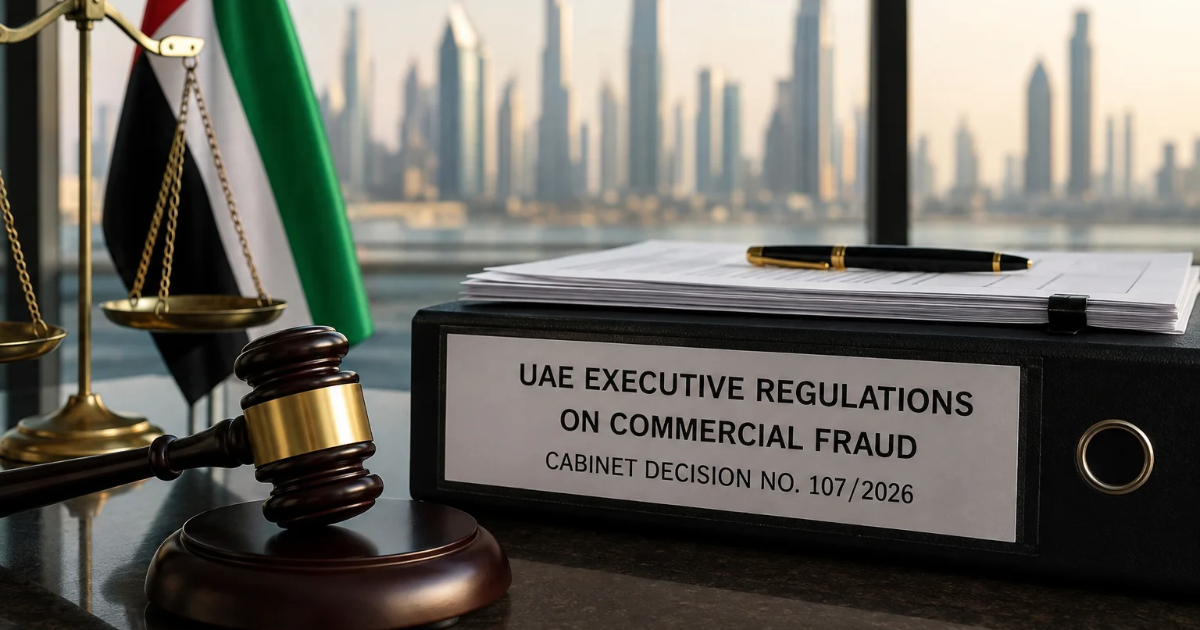
The United Arab Emirates (UAE) has taken a decisive step forward in market surveillance, consumer safety, and intellectual property protection. With the issuance of Cabinet Decision No. 107/2026 (the “Resolution”), the UAE Cabinet officially enacted the Executive Regulations to Federal Decree-Law No. 42/2023 on Combating Commercial Fraud.
Repealing the previous executive regulations, this new regulation establishes a comprehensive operational framework governing how suspected fraudulent, spoiled, adulterated, and counterfeit goods are investigated, seized, recalled, and disposed of across the Emirates.
The Resolution applies throughout the entire UAE, including inside commercial free zones. It impacts all entities within the commercial chain—including importers, exporters, manufacturers, distributors, traders, logistics providers, and digital marketplace operators.
Enhanced Jurisdictional Powers and Inspection Oversight
While local competent authorities in each Emirate maintain primary responsibility for market oversight and local enforcement, the Resolution expands the federal supervisory mandate of the Ministry of Economy and Tourism. The Ministry is empowered to intervene directly where:
- A local competent authority declines or fails to exercise its enforcement powers within prescribed timeframes;
- Suspected non-compliant or counterfeit products are distributed across multiple Emirates; or
- The non-compliance presents severe risks to public health, safety, or the environment.
Judicial Enforcement Officers are granted sweeping inspection powers. They may enter commercial premises, production facilities, warehouses, and transport hubs without prior notice. Crucially, inspection authority explicitly extends to digital systems, databases, e-commerce platforms, electronic communications, and financial/inventory records.
Under standard procedural rules, initial inspections must be concluded within five business days, while official laboratory testing of impounded samples must generally be completed within fifteen business days at the supplier’s expense.
Strict Rapid-Response Product Recall Mandates
Perhaps the most impactful feature of Cabinet Decision No. 107/2026 is its stringent product recall regime. Upon receiving official notification or establishing that products are counterfeit, spoiled, or non-compliant with standard specifications, suppliers must execute a multi-tier action plan:
- Immediate Halt & Initial Withdrawal (24 Hours): Suppliers must immediately cease sale and display, and within 24 hours, withdraw affected goods from markets and storage facilities. Suppliers must also notify all downstream distributors and retail channels within this initial 24-hour window.
- Public Notification (48 Hours): Suppliers are required to publish a bilingual (Arabic and English) recall announcement within 48 hours.
- Comprehensive Recall Reporting (5 Business Days): Within five business days, a formal report documenting complete inventory recovery, downstream communications, and risk mitigation steps must be submitted to the competent authority.
If a business fails or hesitates to execute the mandatory recall within these strict timeframes, the competent authority is empowered to execute the recall and impoundment directly at the violator’s sole expense.
Extended Supply Chain Accountability and Due Diligence
Liability under the new regime is not restricted solely to the original manufacturer or importer. The Resolution clarifies that administrative penalties and sanctions may be levied against distributors, resellers, marketers, and logistics intermediaries who knew, or reasonably ought to have known, that the products handled were counterfeit, adulterated, or non-compliant.
Heightened regulatory scrutiny applies to sensitive sectors, including:
- Medical products and pharmaceuticals;
- Agricultural products, organic foods, and animal feed;
- Misleading or false environmental and origin claims.
Commercial entities must establish rigorous product traceability controls, perform due diligence on third-party suppliers, and maintain verifiable records of origin for all inventory.
Reconciliation Framework and Administrative Settlement
To encourage swift compliance, Cabinet Decision No. 107/2026 provides a formal mechanism for administrative reconciliation. However, access to settlement is subject to strict statutory prerequisites:
- Reconciliation is generally restricted to first-time violations or minor non-compliances resulting from demonstrable error or inadvertent negligence.
- The offender must fully remedy the breach, pay applicable administrative fees/fines, and cover all expenses associated with sample testing, seizure, or safe disposal.
- Reconciliation is strictly barred if the offender has been penalized for a commercial fraud violation under Federal Decree-Law No. 42/2023 within the preceding twelve months.
Competent authorities are required to decide upon formal reconciliation applications within fifteen business days.
Conclusion & Practical Implications
Cabinet Decision No. 107/2026 represents a modern, coordinated, and swift enforcement structure for commercial integrity in the UAE. For businesses operating across onshore and free zone jurisdictions, reactive crisis management is no longer sufficient. Enterprise risk management frameworks must incorporate immediate recall protocols, verifiable supply chain documentation, and strict vendor vetting.
By entering the email address you agree to our Privacy Policy.